What Is the Base of a Trapezoid?
The base of a trapezoid refers to either of the two parallel sides of the shape.
A trapezoid has four sides in total:
- Two bases — the parallel sides (one on top, one on bottom)
- Two legs — the non-parallel sides (left and right)
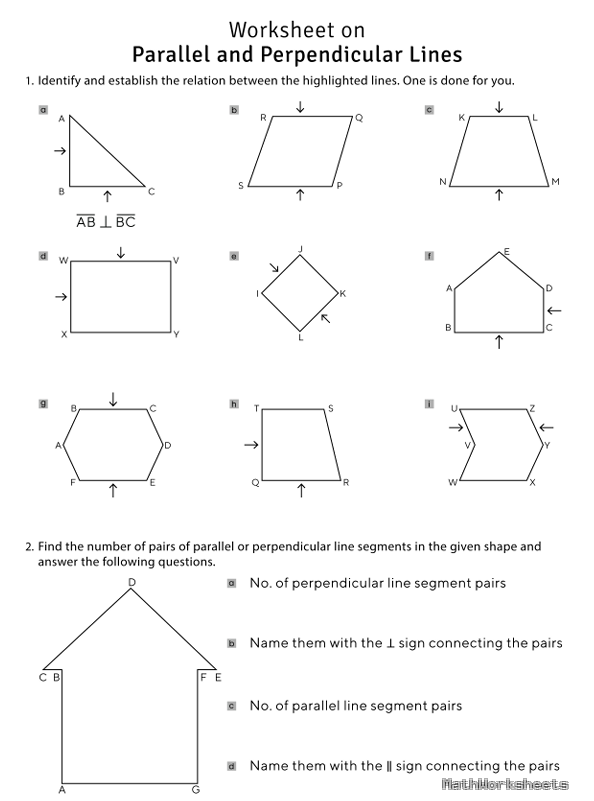
The bases are always the two sides that run parallel to each other — meaning they never meet, no matter how far you extend them.
Top Base vs. Bottom Base
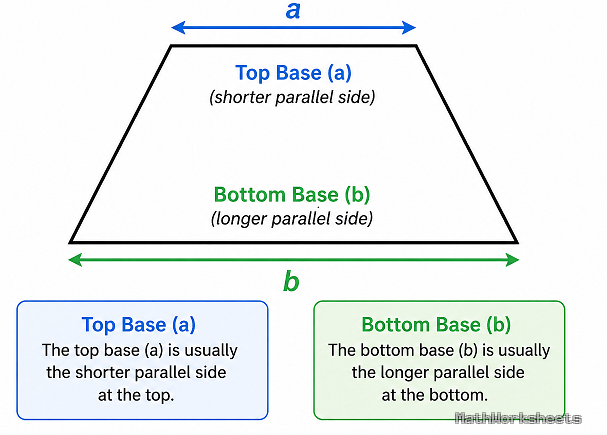
- The bottom base (b) is usually the longer parallel side at the bottom of the trapezoid
- The top base (a) is usually the shorter parallel side at the top
However, in math problems, either parallel side can be called “base 1” and “base 2” — the labeling does not change how you calculate anything.
Base vs. Leg — What Is the Difference?
| Base | Leg | |
|---|---|---|
| Position | Top and bottom | Left and right |
| Relationship | Parallel to each other | Not parallel |
| Used in | Area formula, midsegment formula | Perimeter formula |
Properties of the Bases of a Trapezoid
- A trapezoid always has exactly two bases
- The two bases are always parallel to each other
- The two bases are usually different lengths (except in a parallelogram, where they are equal)
- The height of a trapezoid is always measured perpendicularly (at 90°) between the two bases — never along the leg
- The midsegment of a trapezoid connects the midpoints of the two legs and is always equal to the average of the two bases: Midsegment = (a + b) / 2
How to Find the Base of a Trapezoid
You may need to find a missing base in two common situations:
Method 1 – Using the Area Formula
If you know the area and the height, you can find a missing base.
Formula: Area = (a + b) / 2 × h
Rearranged to find a missing base:
(a + b) = (2 × Area) / h
Then subtract the known base to find the missing one:
b = (2 × Area) / h − a
Method 2 – Using the Midsegment Formula
If you know the midsegment (m) and one base, you can find the other base.
Formula: m = (a + b) / 2
Rearranged: b = 2m − a
Solved Examples
Example 1 – Identifying the Bases
A trapezoid has sides of 6 cm, 10 cm, 5 cm, and 5 cm. The two parallel sides are 6 cm and 10 cm. What are the bases?
Solution:
- Top base (a) = 6 cm
- Bottom base (b) = 10 cm
- The two legs are each 5 cm (non-parallel sides)
Example 2 – Finding a Missing Base Using Area
The area of a trapezoid is 48 cm². The height is 6 cm and one base is 9 cm. Find the other base.
Solution:
b = (2 × Area) / h − a
b = (2 × 48) / 6 − 9
b = 96 / 6 − 9
b = 16 − 9
b = 7 cm
Example 3 – Finding a Missing Base Using the Midsegment
The midsegment of a trapezoid is 11 m and one base is 8 m. What is the other base?
Solution:
b = 2m − a
b = 2(11) − 8
b = 22 − 8
b = 14 m
Example 4 – Real-World Problem
A trapezoidal tabletop has an area of 90 in² and a height of 9 in. The front edge (bottom base) measures 14 in. What is the length of the back edge (top base)?
Solution:
a = (2 × 90) / 9 − 14
a = 180 / 9 − 14
a = 20 − 14
a = 6 in
Practice Questions
Try these on your own! Answers are listed below.
Question 1: A trapezoid has sides 5 cm, 11 cm, 4 cm, and 6 cm. The parallel sides are 5 cm and 11 cm. Identify the top and bottom base.
Question 2: The area of a trapezoid is 70 m², the height is 7 m, and one base is 8 m. Find the missing base.
Question 3: The midsegment of a trapezoid is 9 in and one base is 5 in. Find the other base.
Question 4: A trapezoid has an area of 100 cm², a height of 10 cm, and a bottom base of 15 cm. What is the top base?
Question 5: The two bases of a trapezoid are in a ratio of 1:3. The midsegment is 12 cm. Find both bases.
Answers:
- Top base = 5 cm, Bottom base = 11 cm
- 12 m
- 13 in
- 5 cm
- 6 cm and 18 cm (a + b = 24, ratio 1:3 → a = 6, b = 18)
Frequently Asked Questions (FAQs)
What is the base of a trapezoid?
The base of a trapezoid is either of the two parallel sides. Every trapezoid has exactly two bases — a top base and a bottom base — which are always parallel to each other.
How many bases does a trapezoid have?
A trapezoid always has exactly two bases. These are the only two parallel sides in the shape.
Is the longer side always the base?
The bases are the parallel sides, not necessarily the longest sides. However, in most standard trapezoids, the bottom base is longer than the top base.
What is the difference between a base and a leg?
The bases are the two parallel sides. The legs are the two non-parallel sides. Legs connect the top base to the bottom base on the left and right sides.
Can both bases be the same length?
If both bases are equal in length, the trapezoid becomes a parallelogram (or a rectangle/square in special cases). Most trapezoids have bases of different lengths.