What Is the Perimeter of a Trapezoid?
The perimeter of a trapezoid is the total length of all four sides added together.
Think of it like walking around the outside edge of the shape — the total distance you walk is the perimeter.
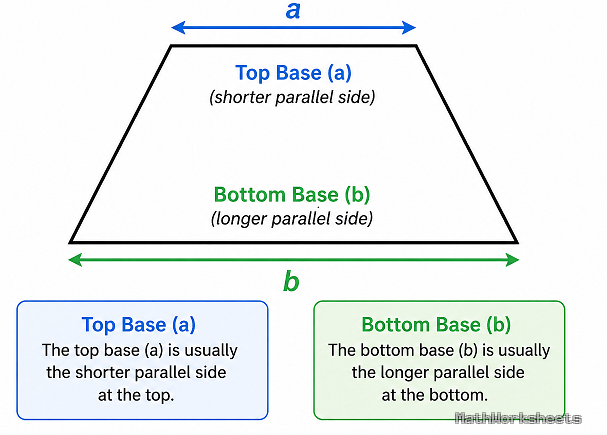
A trapezoid has four sides:
- Two parallel sides called the bases (top base and bottom base)
- Two non-parallel sides called the legs (left leg and right leg)
To find the perimeter, you simply add all four sides together.
Formula for the Perimeter of a Trapezoid
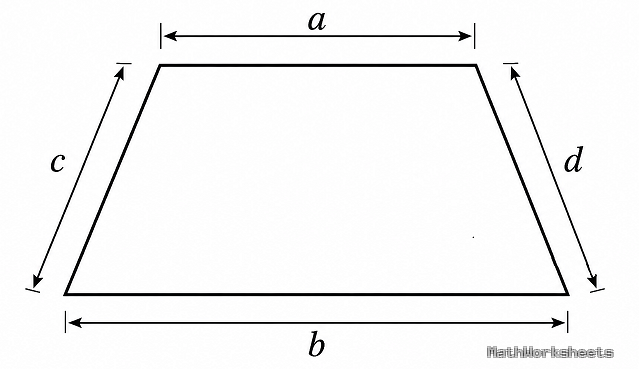
Perimeter = a + b + c + d
Where:
- a = top base
- b = bottom base
- c = left leg
- d = right leg
Special Case – Isosceles Trapezoid
In an isosceles trapezoid, the two legs are equal in length (c = d). So the formula simplifies to:
Perimeter = a + b + 2c
Where c is the length of one leg.
Important note about units:
- If all sides are measured in cm, the perimeter is in cm
- If all sides are measured in m, the perimeter is in m
- If all sides are measured in inches (in), the perimeter is in in
Perimeter is always a single unit (not squared), because you are measuring length — not area.
How to Calculate the Perimeter of a Trapezoid – Step by Step
Follow these 3 simple steps every time:
Step 1: Identify all four sides of the trapezoid — top base (a), bottom base (b), left leg (c), and right leg (d).
Step 2: Make sure all measurements are in the same unit. If not, convert them first.
Step 3: Add all four sides together: Perimeter = a + b + c + d
Solved Examples
Example 1 – Basic Perimeter
A trapezoid has sides of 6 cm, 10 cm, 5 cm, and 5 cm. What is the perimeter?
Solution:
- a = 6 cm
- b = 10 cm
- c = 5 cm
- d = 5 cm
Perimeter = 6 + 10 + 5 + 5
Perimeter = 26 cm
Example 2 – Isosceles Trapezoid
An isosceles trapezoid has a top base of 8 m, a bottom base of 14 m, and each leg is 5 m. Find the perimeter.
Solution:
Perimeter = a + b + 2c
Perimeter = 8 + 14 + 2(5)
Perimeter = 8 + 14 + 10
Perimeter = 32 m
Example 3 – Working Backward (Finding a Missing Side)
The perimeter of a trapezoid is 48 in. Three sides measure 12 in, 18 in, and 9 in. What is the length of the fourth side?
Solution:
48 = 12 + 18 + 9 + d
48 = 39 + d
d = 48 − 39
d = 9 in
Example 4 – Real-World Problem
A farmer wants to put a fence around a trapezoidal field. The four sides measure 20 m, 35 m, 15 m, and 18 m. How many meters of fencing does he need?
Solution:
Perimeter = 20 + 35 + 15 + 18
Perimeter = 88 m
The farmer needs 88 meters of fencing.
Practice Questions
Try these on your own! Answers are listed below.
Question 1: A trapezoid has sides of 7 cm, 13 cm, 6 cm, and 8 cm. What is the perimeter?
Question 2: An isosceles trapezoid has bases of 5 in and 11 in, and legs of 4 in each. Find the perimeter.
Question 3: The perimeter of a trapezoid is 54 m. Three sides are 16 m, 12 m, and 10 m. Find the missing side.
Question 4: A trapezoidal swimming pool has sides measuring 9 ft, 15 ft, 7 ft, and 7 ft. What is the total length around the pool?
Question 5: An isosceles trapezoid has a perimeter of 50 cm. The two bases are 12 cm and 18 cm. What is the length of each leg?
Answers:
- 34 cm
- 24 in
- 16 m
- 38 ft
- 10 cm (50 − 12 − 18 = 20 → 20 ÷ 2 = 10)
Frequently Asked Questions (FAQs)
What is the perimeter of a trapezoid?
The perimeter of a trapezoid is the total distance around the outside of the shape. You find it by adding all four side lengths together: Perimeter = a + b + c + d.
What is the difference between perimeter and area of a trapezoid?
Perimeter measures the total length around the outside of the shape (in cm, m, in, etc.). Area measures the total space inside the shape (in cm², m², in², etc.). They use different formulas and different units.
Do I need the height to find the perimeter?
No. The height is only needed to calculate the area. For the perimeter, you only need the lengths of the four sides.
What if I only know the bases and height, not the legs?
You cannot find the perimeter without knowing the leg lengths. However, if it is a right trapezoid, you can use the Pythagorean theorem to find the slanted leg, as long as you know the height and the horizontal difference between the two bases.
Is the perimeter of an isosceles trapezoid calculated differently?
The concept is the same — add all four sides. But because both legs are equal, you can use the shortcut: Perimeter = a + b + 2c, which saves one step.