What Is the Area of a Trapezoid?
The area of a trapezoid is the total amount of space inside the shape.
A trapezoid is a flat, four-sided shape that has two parallel sides. These two parallel sides are called the bases of the trapezoid — one is longer (the longer base) and one is shorter (the shorter base).
The height of a trapezoid is the straight vertical distance between the two bases. It is always measured at a right angle (90°) to the bases — not along the slanted side.
To find the area, you need to know three things:
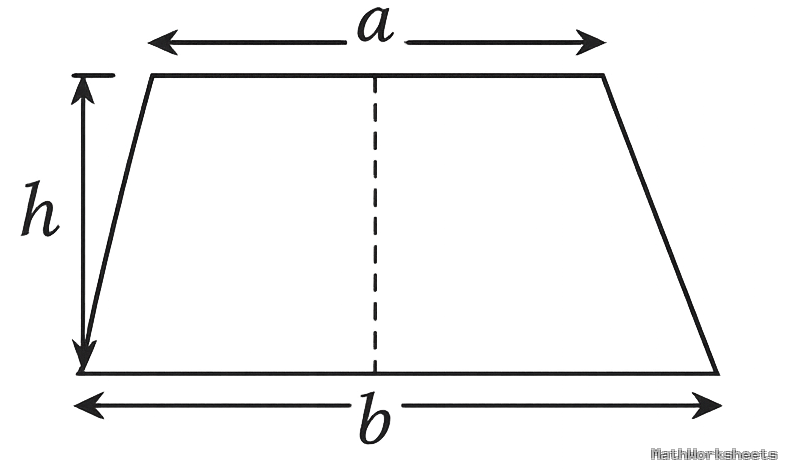
- The length of the first base (a)
- The length of the second base (b)
- The height (h) of the trapezoid
Formula for the Area of a Trapezoid
The formula is:
Area = ½ × (a + b) × h
Or written another way:
Area = (a + b) / 2 × h
Where:
- a = length of the first base (top base)
- b = length of the second base (bottom base)
- h = height of the trapezoid
Why does this formula work?
Think of the trapezoid as an “average” of a rectangle. If you take the average of the two bases — (a + b) / 2 — that gives you the “middle width” of the shape. Then you multiply that middle width by the height, just like finding the area of a rectangle.
Important note about units:
- If the sides are measured in centimeters (cm), the area is in cm²
- If the sides are measured in meters (m), the area is in m²
- If the sides are measured in inches (in), the area is in in²
How to Calculate the Area of a Trapezoid – Step by Step
Follow these 4 simple steps every time:
Step 1: Identify the two bases (a and b) — the two parallel sides.
Step 2: Identify the height (h) — the perpendicular distance between the two bases.
Step 3: Add the two bases together: (a + b)
Step 4: Multiply by the height, then divide by 2: Area = (a + b) / 2 × h
Solved Examples
Example 1 – Basic Calculation
A trapezoid has a top base of 6 cm, a bottom base of 10 cm, and a height of 4 cm. What is its area?
Solution:
- a = 6 cm
- b = 10 cm
- h = 4 cm
Area = (a + b) / 2 × h
= (6 + 10) / 2 × 4
= 16 / 2 × 4
= 8 × 4
= 32 cm²
Example 2 – Finding Area When Height Is Given Separately
A trapezoid has bases of 5 m and 9 m. The height is 3 m. Find the area.
Solution:
= (5 + 9) / 2 × 3
= 14 / 2 × 3
= 7 × 3
= 21 m²
Example 3 – Working Backward (Finding a Missing Base)
The area of a trapezoid is 40 cm². One base is 6 cm and the height is 5 cm. What is the other base?
Solution:
Start with the formula: 40 = (6 + b) / 2 × 5
Divide both sides by 5: 8 = (6 + b) / 2
Multiply both sides by 2: 16 = 6 + b
Subtract 6: b = 10 cm
Practice Questions
Try these on your own! Answers are listed below.
Question 1: A trapezoid has bases of 8 cm and 14 cm, and a height of 6 cm. What is the area?
Question 2: Find the area of a trapezoid with bases 3 in and 7 in, and height 5 in.
Question 3: A trapezoid has an area of 60 m². The two bases are 8 m and 12 m. What is the height?
Question 4: Both bases of a trapezoid are equal at 10 cm, and the height is 4 cm. What is the area? (Hint: What shape does this become?)
Question 5: A garden is shaped like a trapezoid. The two parallel sides measure 15 ft and 25 ft. The distance between them is 10 ft. What is the area of the garden?
Answers:
- 66 cm²
- 25 in²
- 6 m
- 40 cm² (becomes a rectangle)
- 200 ft²
Frequently Asked Questions (FAQs)
What is the area of a trapezoid?
The area of a trapezoid is the total space inside the shape. It is calculated using the formula: Area = (a + b) / 2 × h, where a and b are the two parallel sides (bases) and h is the height.
What is the difference between base and height in a trapezoid?
The bases are the two parallel sides (top and bottom). The height is the perpendicular distance between those two bases — it is always measured straight across at a 90° angle, not along the slanted side.
Can a trapezoid have the same area as a rectangle?
Yes! If both bases of a trapezoid are equal in length, the shape becomes a rectangle, and the area formula gives the same result as length × width.
What units do I use for the area of a trapezoid?
Area is always measured in square units. For example: cm², m², in², ft². If the sides are in cm, the area is in cm².
What if I only know the slanted side, not the height?
You cannot directly use the slanted side as the height. You must find the actual perpendicular height first — sometimes using the Pythagorean theorem if the trapezoid is a right trapezoid.