1. What is the Perimeter of a Rectangle?
The perimeter of a rectangle is the total distance around its outer boundary — the sum of all four sides. If you imagine walking along every edge of a rectangular field and returning to your starting point, the total distance you walk is the perimeter.
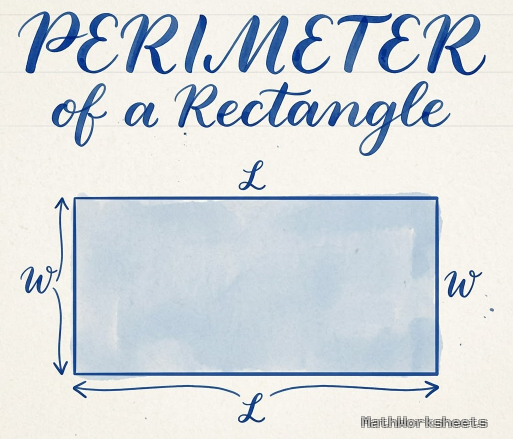
Because a rectangle has two pairs of equal sides (opposite sides are always equal), its perimeter is simply twice the length plus twice the width. Perimeter is measured in units of length — centimetres (cm), metres (m), inches (in), feet (ft) — never in square units.
Key idea: Perimeter = total length of all sides. It measures the boundary, not the space inside.
2. Perimeter of a Rectangle Formula
The standard formula uses length (l) and width (w):
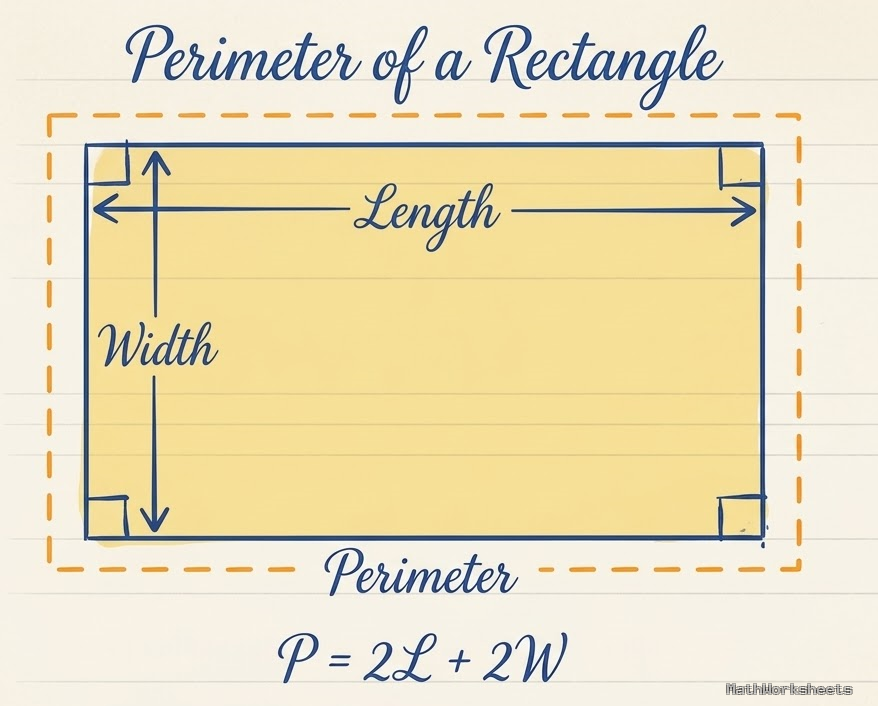
P = 2(l + w) = 2l + 2w
Where:
- P = perimeter (cm, m, in, ft, …)
- l = length — the longer side of the rectangle
- w = width — the shorter side of the rectangle
Both forms of the formula are equivalent and always give the same answer:
| Form | Formula | Meaning |
| Standard (factored) | P = 2(l + w) | Add length and width first, then multiply by 2 |
| Expanded | P = 2l + 2w | Double the length, double the width, then add |
| Sum of all sides | P = l + w + l + w | Add all four sides individually |
SVG diagram: A labeled rectangle with sides l and w, showing all four sides with arrows and the formula P = 2(l + w).
3. How to Find Perimeter — Step by Step
Follow these 4 steps for any rectangle perimeter problem:
Step 1: Identify the length and width.
Read the problem carefully. The length is usually the longer dimension; the width is the shorter one. Label them l and w.
Step 2: Check that both measurements use the same unit.
If length is in metres and width is in centimetres, convert one before calculating.
Step 3: Apply the formula P = 2(l + w).
Add the length and width, then multiply the result by 2.
Step 4: Write your answer with the correct unit.
Perimeter is always in the same unit as the sides — never in square units.
Worked example: A rectangle has length l = 8 cm and width w = 5 cm.
P = 2(l + w) = 2(8 + 5) = 2 × 13 = 26 cm
Answer: 26 cm
4. Finding a Missing Side When Perimeter is Known
This is the type of problem that confuses students most. If you are given the perimeter and one side, you can rearrange the formula to find the missing side.
Starting from P = 2(l + w), rearrange to find w: w = P/2 − l
Similarly, to find the length when width is known: l = P/2 − w
Example: A rectangle has perimeter P = 40 cm and length l = 14 cm. Find the width.
a) Substitute into the formula: w = P/2 − l
b) w = 40/2 − 14
c) w = 20 − 14
d) w = 6 cm
Verification: P = 2(14 + 6) = 2 × 20 = 40 cm ✓
Why P/2? Dividing the perimeter by 2 gives you the sum of one length and one width (l + w). From there, subtracting the known side gives the missing side.
5. Area vs Perimeter — What is the Difference?
Students often mix up area and perimeter because both involve the dimensions of a rectangle. The key difference is:
| Perimeter | Area | |
| What it measures | Distance around the boundary | Space inside the shape |
| Formula | P = 2(l + w) | A = l × w |
| Unit | cm, m, in, ft | cm², m², in², ft² |
| Example (l=8, w=5) | P = 26 cm | A = 40 cm² |
| Real-world use | Fencing, framing, borders | Carpet, flooring, paint |
Visual shortcut: Perimeter = distance around (think of a running track). Area = space inside (think of carpet on the floor). A rectangle can have the same perimeter as another shape but a completely different area.
Example: A 6 × 2 rectangle and a 4 × 4 square both have perimeter = 16. But their areas are different: 6×2 = 12 cm² vs 4×4 = 16 cm².
6. Perimeter Word Problems — 6 Solved Examples
Word problems are the core differentiator of this article. Each example below follows the same structure: understand the setup, extract the data, solve step by step.
Word Problem 1: Fencing a Garden
A homeowner wants to build a fence around a rectangular garden. The garden is 12 metres long and 7 metres wide. How many metres of fencing does she need?
Given: l = 12 m, w = 7 m
Solution:
P = 2(l + w)
P = 2(12 + 7)
P = 2 × 19
P = 38 m
Answer: She needs 38 metres of fencing.
Word Problem 2: Framing a Picture
A photographer wants to put a wooden frame around a rectangular photograph. The photo is 25 cm long and 18 cm wide. What is the total length of wood needed for the frame?
Given: l = 25 cm, w = 18 cm
Solution:
P = 2(l + w)
P = 2(25 + 18)
P = 2 × 43
P = 86 cm
Answer: 86 cm of wood is needed for the frame.
Word Problem 3: Running Track
A school has a rectangular running track that is 80 metres long and 45 metres wide. A student runs 4 complete laps around the track. How far does the student run in total?
Given: l = 80 m, w = 45 m, laps = 4
Solution:
- Step 1 — Perimeter of one lap: P = 2(80 + 45) = 2 × 125 = 250 m
- Step 2 — Total distance: 250 × 4 = 1000 m
Answer: The student runs 1000 metres (1 km) in total.
Word Problem 4: Floor Tiling Border
A rectangular room is 6 m long and 4.5 m wide. A decorator wants to place a border tile along all four walls at floor level. How many metres of border tile are needed?
Given: l = 6 m, w = 4.5 m
Solution:
P = 2(l + w)
P = 2(6 + 4.5)
P = 2 × 10.5
P = 21 m
Answer: 21 metres of border tile are needed.
Word Problem 5: Dog Pen Fencing
A farmer has 60 metres of fencing and wants to build a rectangular pen for his dog. He wants the length to be twice the width. What are the dimensions of the pen?
Given: P = 60 m, l = 2w (length is twice the width)
Solution:
Substitute l = 2w into P = 2(l + w):
60 = 2(2w + w)
60 = 2 × 3w
60 = 6w
w = 10 m → l = 2 × 10 = 20 m
Verification: P = 2(20 + 10) = 2 × 30 = 60 m ✓
Answer: Width = 10 m, Length = 20 m.
Word Problem 6: Wallpaper Border
A decorator wants to hang a wallpaper border around the top of a rectangular bedroom. The room measures 5.2 m × 3.8 m. The border is sold in rolls of 10 m each. How many rolls does she need to buy?
Given: l = 5.2 m, w = 3.8 m
Solution:
- Step 1 — Perimeter: P = 2(5.2 + 3.8) = 2 × 9 = 18 m
- Step 2 — Rolls needed: 18 ÷ 10 = 1.8 → round up to 2 rolls
(She cannot buy 0.8 of a roll, so she must buy 2 complete rolls.)
Answer: She needs to buy 2 rolls of wallpaper border.
7. Common Mistakes to Avoid
Mistake 1: Adding only 2 sides instead of 4. Some students write P = l + w, forgetting that a rectangle has four sides, not two. The correct formula always multiplies by 2: P = 2(l + w).
Mistake 2: Confusing area with perimeter. Perimeter uses the unit of length (cm, m). Area uses square units (cm², m²). If your answer has a ² symbol, check whether you used the right formula.
Mistake 3: Writing l × w instead of 2(l + w). Multiplying l × w gives the area, not the perimeter. For perimeter, you add l and w first, then multiply by 2.
8. Practice Problems
Solve each problem, then check your answer below.
a) A rectangle has l = 9 cm and w = 4 cm. Find the perimeter.
→ Answer: P = 2(9 + 4) = 2 × 13 = 26 cm
b) A rectangle has perimeter = 48 m and width = 10 m. Find the length.
→ Answer: l = 48/2 − 10 = 24 − 10 = 14 m
c) A square has side = 7 cm. What is its perimeter? (A square is a rectangle where l = w.)
→ Answer: P = 2(7 + 7) = 2 × 14 = 28 cm (or: 4 × 7 = 28 cm)
d) A garden is 15.5 m long and 8.25 m wide. How much fencing is needed?
→ Answer: P = 2(15.5 + 8.25) = 2 × 23.75 = 47.5 m
e) (Challenge) Two rectangles have the same perimeter of 36 cm. Rectangle A is 11 × 7 cm. Rectangle B is 10 × ? cm. Find the missing width of Rectangle B.
→ Answer: P = 36 → l + w = 18 → 10 + w = 18 → w = 8 cm
9. Frequently Asked Questions
What is the perimeter of a rectangle with length 7 cm and width 4 cm?
P = 2(7 + 4) = 2 × 11 = 22 cm. This is a direct application of the formula P = 2(l + w). Always add the two different dimensions first, then multiply by 2.
What is the formula for the perimeter of a rectangle?
P = 2(l + w), where l = length and w = width. This can also be written as P = 2l + 2w. Both forms give identical results — use whichever is easier for you.
Is perimeter the same as area?
No. Perimeter measures the total boundary length (in cm, m, etc.) — the distance around the outside. Area measures the space inside the shape (in cm², m²). A rectangle with l = 8 and w = 5 has perimeter = 26 cm but area = 40 cm².
How do you find the missing side of a rectangle if you know the perimeter?
Rearrange the formula: w = P/2 − l. Divide the perimeter by 2 to get (l + w), then subtract the known side. For example, if P = 40 and l = 14: w = 40/2 − 14 = 20 − 14 = 6.
Can a rectangle have the same perimeter as a square?
Yes. A 6 × 2 rectangle and a 4 × 4 square both have perimeter = 16. However, their areas are different: the rectangle has area 12 cm² while the square has area 16 cm². Equal perimeter does not mean equal area.
10. What to Learn Next
You can now calculate the perimeter of any rectangle. Here are the natural next steps:
→ Area of a Rectangle — Now that you know the perimeter (distance around), learn how to find the area (space inside) using A = l × w. Similarly, you can find the area inside a triangle using the methods covered in our Area of a Triangle guide.
→ Perimeter of Other Shapes — Apply the same boundary-measurement concept to triangles, circles (circumference), and irregular polygons.
→ Rectangle Properties — Explore deeper properties of rectangles: diagonal length, relationship to squares, and how rectangles are used in coordinate geometry.