1. What is the Area of a Triangle?
The area of a triangle is the total region enclosed by its three sides, measured in square units. In other words, it is the amount of two-dimensional space that lies inside the triangle.
Area is always expressed in square units — for example, cm², m², in², or ft² — because we are measuring a two-dimensional surface. The basic formula uses two measurements: the base (any side of the triangle) and the height (the perpendicular distance from that base to the opposite vertex).
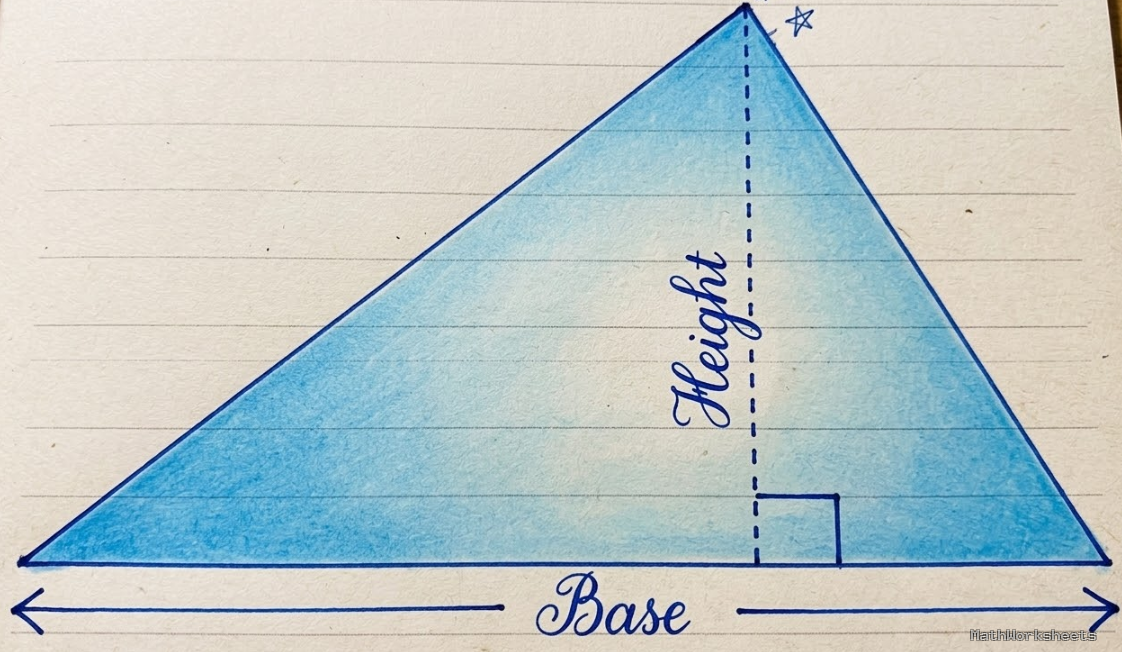
A = ½ × base × height
Where A = area (in square units), base = length of the chosen side, height = perpendicular height to that side.
2. Area of a Triangle Formula
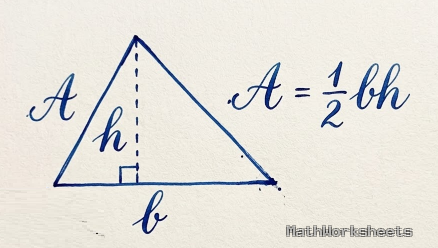
The most commonly used formula is A = ½ × b × h, where:
- A = area of the triangle (cm², m², in², ft², …)
- b = base — any side you choose as the reference
- h = height — the perpendicular distance from the base to the opposite vertex
This formula works for all types of triangles — right triangles, acute triangles, obtuse triangles, equilateral triangles, and isosceles triangles — as long as you use the perpendicular height, not a slanted side.
$A = \frac{1}{2} b h$
3. Why Does the Formula Have ½?
A triangle is exactly half of a parallelogram (or rectangle) with the same base and height. If you take any triangle and duplicate it, you can always fit the two copies together to form a parallelogram. Since the area of a parallelogram is base × height, the area of the triangle is half of that.
This is why every triangle area formula contains the factor ½ — it reflects this fundamental geometric relationship. Understanding this “why” helps you remember the formula rather than just memorising it.
4. How to Find the Area — Step by Step
There are 5 methods for finding the area of a triangle, depending on what information you have. Choose the method that matches your known values:
Method 1: Base and Height Known
This is the standard method. Use it whenever you know (or can measure) the base and the perpendicular height.
$A = \frac{1}{2} \times b \times h$
Example 1 — Integers: A triangle has base = 6 cm and height = 4 cm.
A = ½ × 6 × 4 = ½ × 24 = 12 cm²
Example 2 — Decimals: A triangle has base = 8.5 cm and height = 3.2 cm.
A = ½ × 8.5 × 3.2 = ½ × 27.2 = 13.6 cm²
Example 3 — Word problem: A farmer wants to fence a triangular garden. The base is 12 m and the perpendicular height is 5 m. What is the area?
A = ½ × 12 × 5 = ½ × 60 = 30 m²
Tip: The height must be perpendicular to the base. If a problem gives you a slant side instead, use Heron’s formula (Method 2) or the SAS formula (Method 3).
Method 2: Three Sides Known (Heron’s Formula)
When you know all three side lengths but not the height, use Heron’s formula. It works for any triangle.
Step 1: Calculate the semi-perimeter: $s = (a + b + c) / 2$
Step 2: Apply Heron’s formula: $A = \sqrt{ s(s – a)(s – b)(s – c) }$
Example 1: Triangle with sides a = 3, b = 4, c = 5.
s = (3 + 4 + 5) / 2 = 6
A = √( 6 × (6−3) × (6−4) × (6−5) ) = √( 6 × 3 × 2 × 1 ) = √36 = 6 cm²
Note: 3-4-5 is a right triangle, so you can verify using Method 1: A = ½ × 3 × 4 = 6 cm² ✓
Example 2: Triangle with sides a = 5, b = 12, c = 13.
s = (5 + 12 + 13) / 2 = 15
A = √( 15 × (15−5) × (15−12) × (15−13) ) = √( 15 × 10 × 3 × 2 ) = √900 = 30 cm²
Method 3: Two Sides and Included Angle (SAS)
If you know two sides and the angle between them (the included angle), use the SAS formula: $A = \frac{1}{2} \times a \times b \times \sin(C)$
Where a and b are the two known sides, and C is the included angle between them.
Example: Two sides of length a = 8 cm and b = 10 cm with an included angle C = 30°.
A = ½ × 8 × 10 × sin(30°) = ½ × 8 × 10 × 0.5 = 20 cm²
Remember: Use the sine of the included angle. Make sure your calculator is set to degrees (not radians) when working with degree angles.
Method 4: Coordinate Geometry
When a triangle is defined by three coordinate points — (x₁, y₁), (x₂, y₂), (x₃, y₃) — use the Shoelace formula:
$A = \frac{1}{2} \left| x_1(y_2 – y_3) + x_2(y_3 – y_1) + x_3(y_1 – y_2) \right|$
The absolute value ensures the result is always positive, regardless of the order in which you list the vertices.
Example: Triangle with vertices at A(1, 2), B(4, 6), C(7, 2).
A = ½ |1(6 − 2) + 4(2 − 2) + 7(2 − 6)|
A = ½ |1×4 + 4×0 + 7×(−4)|
A = ½ |4 + 0 − 28| = ½ × |−24| = ½ × 24 = 12 square units
Method 5: Equilateral Triangle
An equilateral triangle has all three sides equal. There is a dedicated formula derived from Heron’s formula that is faster to apply:
$A = \left(\frac{\sqrt{3}}{4}\right) \times a^2$
Where a is the length of any side.
Example: An equilateral triangle with side a = 6 cm.
$A = (\sqrt{3} / 4) \times 6^2 = (\sqrt{3} / 4) \times 36 = 9\sqrt{3} \approx 15.59 \text{ cm}^2$
5. Formula Summary Table
Use this table to quickly choose the right method for your problem:
|
Method |
Formula |
When to use |
Example |
|
1. Base & Height |
A = ½ × b × h |
Height is known |
b=6, h=4 → A=12 cm² |
|
2. Heron’s |
A = √(s(s−a)(s−b)(s−c)) |
All 3 sides known, no height |
3,4,5 → A=6 cm² |
|
3. SAS |
A = ½ ab sin(C) |
2 sides + included angle |
8,10,30° → A=20 cm² |
|
4. Coordinates |
A = ½|x₁(y₂−y₃)+x₂(y₃−y₁)+x₃(y₁−y₂)| |
Vertices given as (x,y) |
(1,2),(4,6),(7,2) → 12 |
|
5. Equilateral |
A = (√3/4)a² |
All sides equal |
a=6 → A≈15.59 cm² |
6. Common Mistakes to Avoid
Mistake 1: Forgetting the ½ — This is the most common error. Students often write A = b × h instead of A = ½ × b × h. Always remember: a triangle is half a parallelogram.
Mistake 2: Using a slant side as the height — The height must be the perpendicular distance from the base to the opposite vertex. If a problem labels a slant edge as the height, use Method 3 (SAS) or Heron’s formula instead.
Mistake 3: Mixing up units (cm vs cm²) — Area is always in square units. If base = 5 cm and height = 4 cm, then area = 10 cm² (not 10 cm). Including the correct unit is essential in exams.
7. Practice Problems
Try these problems yourself. Solutions are shown beneath each question.
a) A triangle has base = 10 cm and height = 6 cm. Find the area.
→ Answer: A = ½ × 10 × 6 = 30 cm²
b) A triangle has sides 7 cm, 24 cm, and 25 cm. Use Heron’s formula to find the area.
→ Answer: s = 28; A = √(28×21×4×3) = √7056 = 84 cm²
c) Two sides of a triangle are 9 m and 12 m. The included angle is 60°. Find the area.
→ Answer: A = ½ × 9 × 12 × sin(60°) = ½ × 9 × 12 × 0.866 ≈ 46.77 m²
d) A triangular plot has vertices at (0,0), (6,0), and (3,4). Find its area.
→ Answer: A = ½|0(0−4)+6(4−0)+3(0−0)| = ½|0+24+0| = 12 square units
e) (Challenge) An equilateral triangle has a perimeter of 18 cm. Find the area.
→ Answer: Side = 6 cm; A = (√3/4) × 36 = 9√3 ≈ 15.59 cm²
8. Frequently Asked Questions
What units is triangle area measured in?
Square units — cm², m², in², ft², etc. The unit of area is always the square of the unit of length. If your measurements are in centimetres, the area is in cm². Never write area in plain cm or m.
Why is the area of a triangle half of a rectangle?
Any triangle can be seen as exactly half of a parallelogram (or rectangle) with the same base and height. If you duplicate the triangle and flip the copy, the two pieces fit together to form a parallelogram. Therefore the triangle is always exactly half.
Can the area of a triangle be negative?
No — area is always positive. If you use the coordinate (Shoelace) formula and get a negative number inside, take the absolute value. Area represents a physical quantity (size of a region) and cannot be negative.
How do you find the area of a triangle with 3 sides?
Use Heron’s formula. First calculate the semi-perimeter: s = (a + b + c) / 2. Then apply A = √(s(s−a)(s−b)(s−c)). This works for any triangle when all three side lengths are known.
What is the formula for the area of a triangle?
A = ½ × base × height. This gives the area in square units when the base and the perpendicular height are both known. If you don’t know the height, you can use Heron’s formula (for three sides) or the SAS formula (for two sides and an angle).
9. What to Learn Next
Now that you understand how to find the area of a triangle, you are ready to explore related topics:
- Prerequisite: Types of Angles — Understanding acute, right, and obtuse angles will help you work with the SAS formula and recognise when a triangle has a 90° angle.
- Related: Types of Triangles — Learn the properties of equilateral, isosceles, scalene, right, and obtuse triangles, and how each one affects which area formula to use.
- Next step: Pythagorean Theorem — Once you can find the area, the Pythagorean Theorem lets you find missing sides in right triangles, which often feeds back into the area calculation.